

The three moves
The Italian Opening is one of the oldest ways to start a game, and it is still a good first opening. It takes three moves, and each one develops a piece or a pawn.
- 1.e4 e5. Both players put a pawn in the center.
- 2.Nf3 Nc6. White’s knight attacks the e5 pawn. Black defends it with the other knight.
- 3.Bc4. The light-squared bishop comes to c4. That is the move that makes it the Italian.
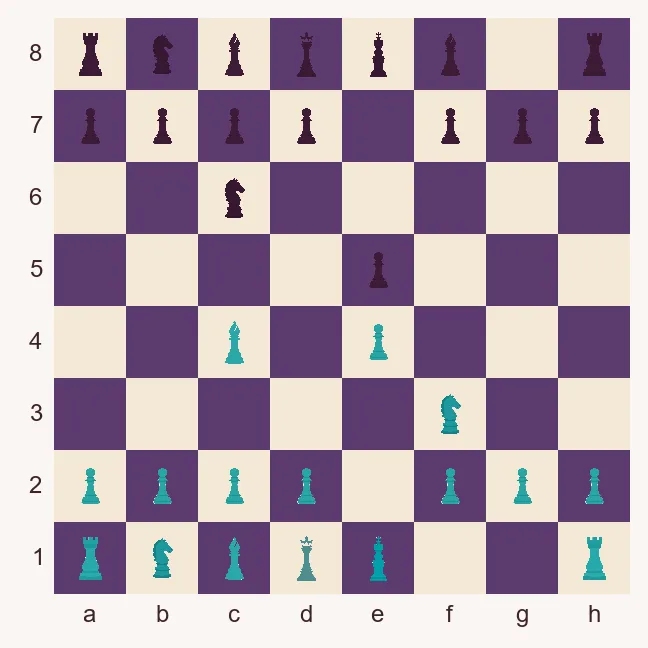
Say the moves as you play them. e4, Nf3, Bc4. After that, White is one move from castling.
Why the bishop goes to c4
f7 is the softest point in Black’s camp at the start of the game. Only the king defends it. From c4 the bishop looks straight down that diagonal, through the empty squares d5 and e6, and on to f7.
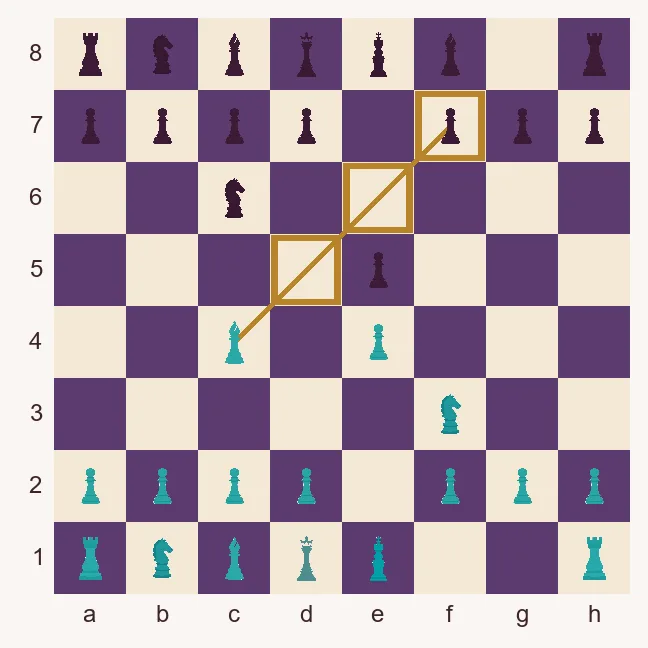
The bishop is not taking the pawn. It is developed, it eyes a weakness, and the king can still castle. Leave the capture for later, when more pieces join the attack.
Two replies you will see
3...Bc5. Black copies the idea. The dark-squared bishop comes to c5 and looks at your f2 pawn. This branch is called the Giuoco Piano, the quiet game. Both sides finish developing and castle.
3...Nf6. Black’s knight attacks your pawn on e4. This is the Two Knights Defense. Answer that threat before you go hunting on f7. A pawn defended by d3, or a knight developed to c3, is enough for a first game.
Three habits
- Knight before the bishop. Nf3 comes on move two, so the e5 pawn is attacked and the king is one move from castling.
- Castle. After Bc4, get the king off e1 before you open the center.
- Leave f7 alone on move four. The bishop’s aim is a plan, not a capture. Taking the pawn that early usually loses the piece.
Play the same three moves until they are automatic. Then notice which reply you are facing before you choose a fourth move.
Watch next
Two lessons put a board under the same ideas. Stjepan Tomic walks through the branches of the Italian. Grandmaster Igor Smirnov then shows the plans, including the pressure on f7, without a pile of memorized lines.
Italian Game: Opening Basics and Common Variations — Hanging Pawns
Italian Game Every Single Line Explained — Remote Chess Academy