
Chess is not only about planning many moves ahead. Very often a game is decided by a tactical opportunity: a short sequence that wins material, builds an attack, or delivers checkmate.
These ten patterns show up at every level. Learn to see them, and you will also stop walking into them.
1. The fork
A fork happens when one piece attacks two or more enemy pieces at the same time. The knight is famous for this, because it jumps and the two targets do not have to stand on the same line.
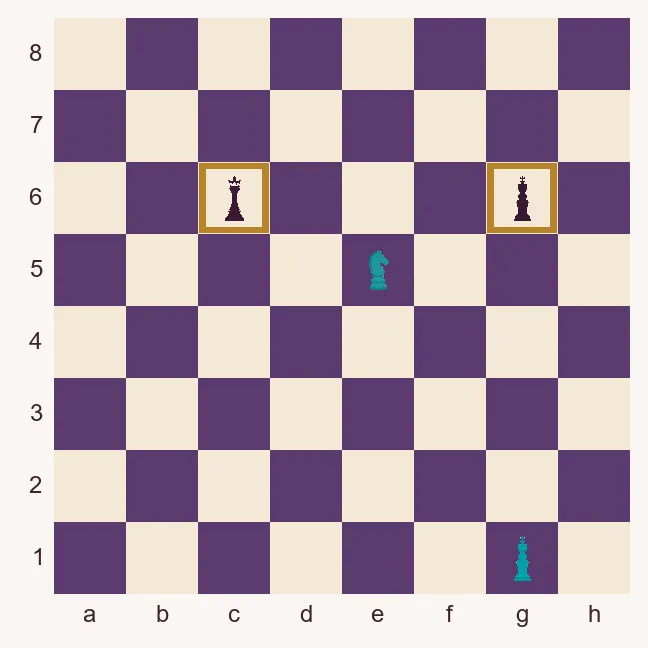
Here the knight on e5 checks the king on g6 and attacks the queen on c6 at the same time. The king must step out of check, and the queen can be taken on the next move.
Tip: Look for knight moves that attack two valuable pieces at once.
2. The pin
A pin occurs when a piece cannot move, or should not move, because something more valuable stands behind it. If moving it would expose the king, the piece cannot legally move at all.
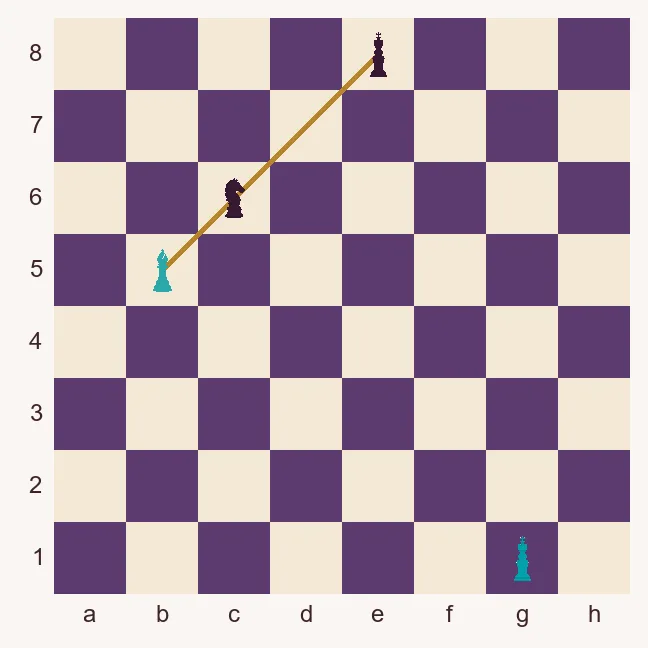
The bishop on b5 looks through the knight on c6 to the king on e8. The knight is stuck. Pins also work against a queen or a rook: the piece in front can move, but doing so gives the piece behind away.
Tip: Look for a piece standing in front of something more valuable.
3. The skewer
A skewer is a pin turned around. The more valuable piece is in front, so it has to move, and the piece behind it is lost.
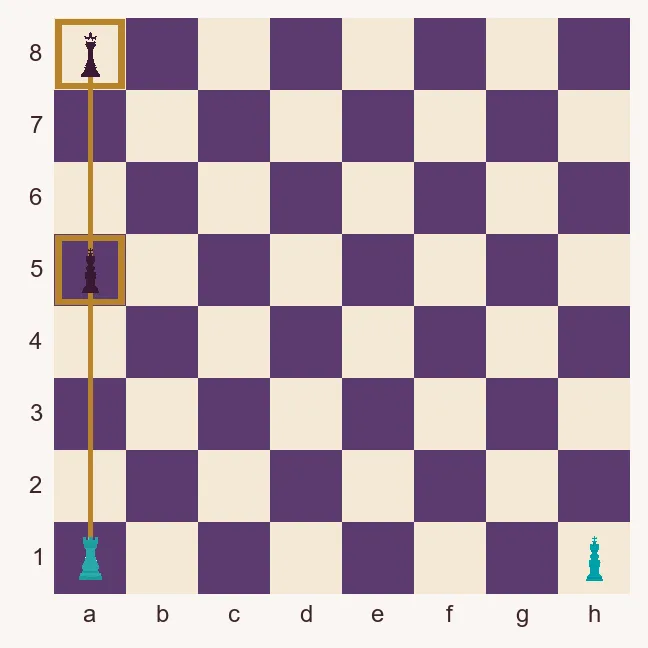
The rook on a1 checks the king on a5. The queen sits further up the same file, on a8. The king must leave the file, and the queen is then taken.
Tip: Look for enemy pieces lined up on the same rank, file, or diagonal.
4. Discovered attack
A discovered attack happens when one piece moves away and uncovers an attack from a piece behind it. A knight steps off a diagonal, and the bishop behind it suddenly attacks the queen.
These are strong because the piece that moves can make a second threat at the same time. When the uncovered attack is check, it is a discovered check.
5. Double attack
A double attack means one move creates two threats. A fork is one kind: a single piece hits two targets. A double attack can also use two pieces, as when you move a piece onto the queen and, with the same move, open a line for another attacker.
Your opponent may only have time to answer one of the threats.
6. The sacrifice
Sometimes the best move is to give a piece away. A sacrifice can open the king, remove a defender, or force mate a move or two later. It can also win the material back with interest.
Not every sacrifice is sound. Before you give the piece, calculate what happens if your opponent takes it.
Remember: a sacrifice needs a clear purpose.
7. Removing the defender
Pieces guard other pieces and important squares. If you can capture or distract the guard, the thing it protected may fall.
A knight may be the only piece defending the queen. Capture that knight, or pull it away, and the queen is loose. Before you grab, ask what is protecting the piece or the square.
8. Back-rank tactics
A back-rank tactic appears when a king is trapped behind its own pawns. A rook or queen on the last rank can then deliver mate, because the king has no square to step to.
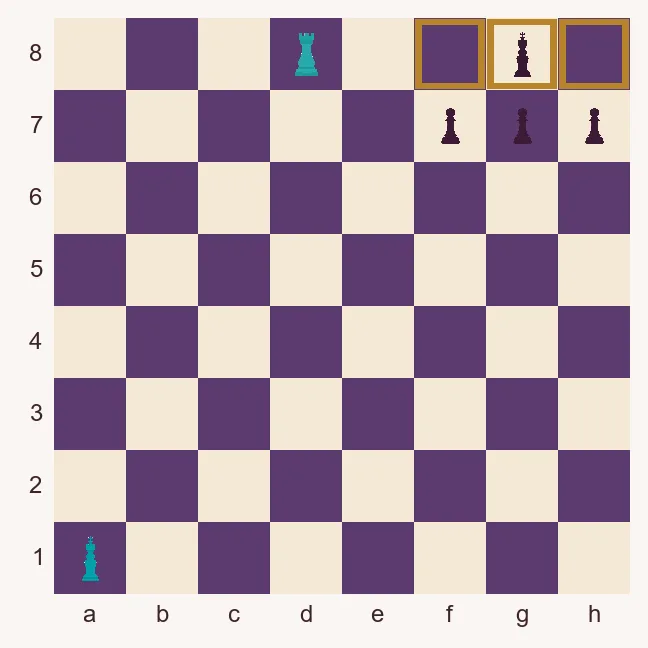
The king on g8 cannot use f7, g7, or h7, because its own pawns stand there. The rook on d8 covers the rest of the eighth rank. That is mate. Giving the king an escape square, sometimes called giving the king some air, stops this.
9. Deflection
A deflection forces a defending piece to leave its job. A rook may be the only piece guarding the back rank. If you can force that rook to move, the mate from the previous diagram becomes possible.
Ask whether you can make that piece leave the square it needs to hold.
10. Checkmate patterns
Knowing a few mating pictures lets you spot a win without calculating the whole game. Start with these:
- Back-rank mate, as in the diagram above.
- Smothered mate, when a knight checks a king boxed in by its own pieces.
- Ladder mate, when two rooks walk the king to the edge, rank by rank.
- Queen and rook attacks, where the heavy pieces cut off the king’s escape.
The more of these you have seen, the faster you notice them in a real game.
How to get better at tactics
- Solve a few tactical puzzles each day.
- Before every move, look for checks, captures, and threats.
- Review your games and mark the tactics you missed.
- Play through short games that turn on one combination.
- Calculate the reply before you give material away.
A useful order for a beginner is checks, then captures, then threats. Look for a forcing move before you play a quiet one.
Watch next
Two lessons from Chess Vibes cover the same ground on a board. The first is forks, pins, and skewers. The second continues with double attacks, discovered check, and removing a defender.
The Chess Tactics Guide For Beginners — Chess Vibes
Chess Tactics for Beginners, Part 2 — Chess Vibes